
Prior knowledge in science lessons
 I think we can all empathise with the feeling of frustration, when someone insists on showing us how to do something that we can already do. It might be how to tie a knot, how to navigate a roundabout or spell a specific word. Similarly, it can be equally frustrating to be asked to do something that you can’t.
Learning science is similar. Students arrive into our lessons with an enormous amount of prior knowledge that we need to take account of. Some of this prior knowledge will be right, allowing students to answer questions correctly, solve problems and carry out practical work successfully. Some of this prior knowledge will, though, of course, be scientifically wrong. Indeed, some students will arrive with deeply held misconceptions e.g. thinking that plants get their food from the soil, a force is needed to keep something moving or that humans evolved from chimps that will require repeated encounters with the scientific ideas over many years to resolve.
Prior knowledge is particularly important when it comes to learning because it provides the framework for learning new things. Any new knowledge students learn has to be first assimilated in relation to what they already know. This, in turn, then leads to the construction of more elaborate schemata (knowledge structures in the mind). This is the cognitive rationale (as opposed to the motivational rationale) for making science lessons relevant to students (Carey, 1986).
If science teachers don’t activate and take account of students’ prior knowledge at the start of a lesson or topic:
- We risk boring those students who already have some understanding.
- We can’t support students to make links between what they know already and the new knowledge – this is important for making learning meaningful.
- We remove the opportunity to practise retrieval – an important part of memory making.
- We remove the opportunity for identifying and addressing student misconceptions.
The impossible task
The task of trying to find out what 30 students already think is not an easy one. It’s actually impossible! However, we can gain an overall impression of the collective prior knowledge of the class by asking some good questions and listening closely to the answers and then using this information to teach responsively, both in the current lesson and future lessons.
For example, if teaching evolution to Year 9, you might want to find out what students can remember about competition, variation, reproduction and Darwin. You may also want to know what other experiences students are bringing to the classroom e.g. some may have watched Jurassic Park or even visited the Galapagos Islands. All of this information can then be used to adapt the current lesson (e.g. students don’t know the term variation so let’s teach this using the whiteboard) over future lessons (students are saying that we evolved from chimps so let’s plan an activity around common ancestors for the next lesson).
Below are some strategies that I have found useful to explore and activate prior knowledge at the start of a science lesson or topic.
 What do I, my partner and class already know?

Using spider diagrams to assess prior knowledge in science. Students complete a spider diagram on a topic chosen by the teacher. This example is for exothermic reactions. Students brainstorm on their own what they already know about exothermic reactions. They then share their ideas with their partner and add to their spider diagram. Finally, the class discuss their ideas as a group and the teacher/student adds this to a class spider diagram on the board. The teacher can walk around during the activity to identify misconceptions and ascertain understanding. This can inform the next phase of the lesson. (PDF)
Silent group retrieval practice
Students work silently in groups of four to annotate and develop ideas around specific stimuli. This could simply be a question, equation, word or a series of images. Each student gets time at annotating each quadrant. This idea is probably best understood by clicking here.
Ask students to draw concept maps
A concept map can be a useful way to assess prior knowledge. It’s similar to the spider diagram above but a little more complex as it asks students to think more about the relationship between knowledge and how it fits together into a hierarchical structure. Concept mapping was originally developed by Joseph Novak as a means of representing frameworks for the interrelationships between concepts (Novak & Gowin, 1984). If you are going to use concept maps make sure students are confident first on how to draw them. Click here for an excellent summary of concept maps.
Assessing prior knowledge by getting students to ask the questions
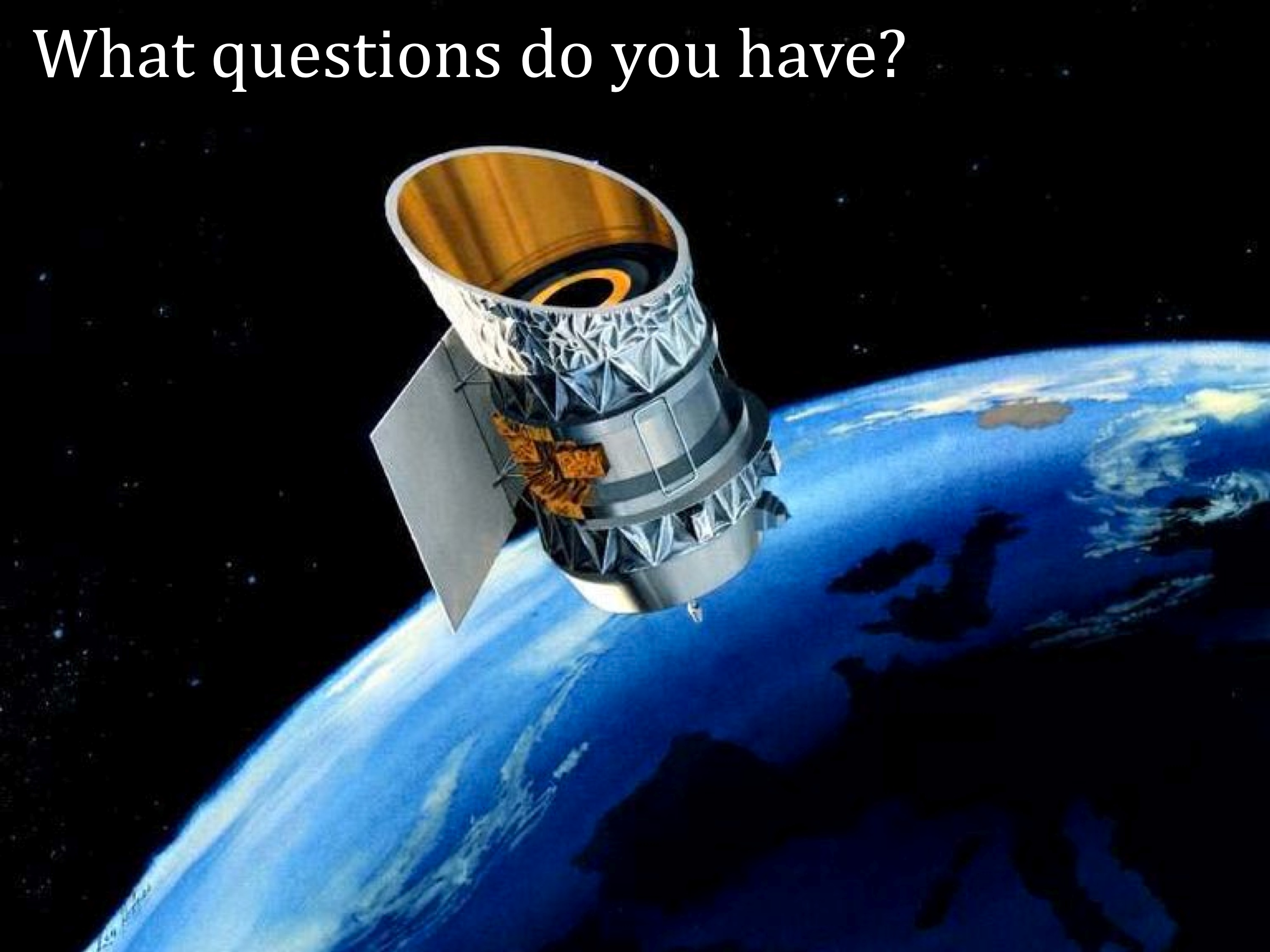 Imagine you are teaching the first lesson on satellites. You don’t want to start your lesson by assuming students know nothing about satellites, but are unsure of what they already do know. A useful approach is to show an inspiring image and ask: what questions do you have? The subsequent questions asked by the class will reveal a great deal about prior knowledge and identify class experts. For example, a student who asks, “What shape is the orbit?” is clearly familiar with the term orbit and understands that orbits have different shapes.
You will be amazed by the creativity of the questions in your class. Examples from this image included: How old is it? How did it get there? Did the Russians put it there? What speed is it travelling at? Are those solar panels?
Using diagnostic MCQ questioning
The AAAAS Project 2061 Science Assessment Website provides free access to some fantastic diagnostic MCQ questions to assess students’ understanding and identify misconceptions. The multiple choice science test items assess students’ conceptual understanding, not just facts and definitions in isolation. They also test for common misconceptions and alternative ideas students may have. Other sources for MCQs are listed here.
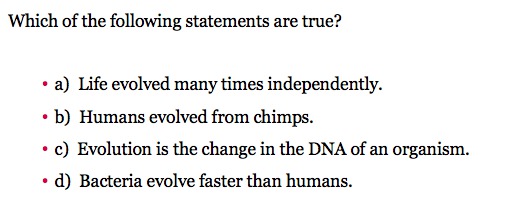
You can also make your own MCQs. This question on evolution provided the stimulus for some really fruitful conversations about evolution and natural selection that helped to make prior knowledge visible.
Ask students to draw a picture
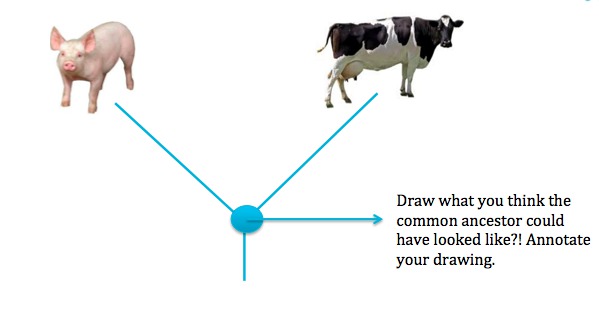 If the question is right then a picture can paint a 1000 words. The conditions for the task need to be made really clear so that all students complete it, whether they enjoy drawing or not and in a clear time frame! It is really important that you ask students to annotate the features of the drawing so you can visualise their thinking. In this example, are students drawing an ancestor that has features shared by both the cow and the pig, or are they drawing a half-cow half-pig misconception!?
Further reading
- Carey, S. (1986). Cognitive science and science education. American Psychologist, 41(10), p.1123-1130.
- Driver, R. (2008) The pupil as scientist? Open University Press.
- Driver, R., Squires, A., Rushworth, P. & Wood-Robinson, V. (1994) Making sense of secondary science: Research into children’s ideas. Routledge.
- Novak, J.D. (1991). Clarify with Concept Maps: A tool for students and teachers alike. The Science Teacher, 58(7), 45-49.
- Novak, J.D. & Gowin, D.B. (1984). Learning how to learn. Cambridge University Press.
- Planning lessons: the EPIBA approach
- Clearly defined lesson objectives
- The Do Now
- Activate prior knowledge
- Challenge your students
- Use a context
- Challenge all students appropriately
- Use direct instruction to provide clear explanations
- Model abstract ideas in concrete ways
- Use questioning to probe understanding
- Check for understanding – give and get feedback
- Troubleshooting – why did it go wrong?
Leave a Reply