
How to challenge students when planning science lessons?
The idea of challenge tends to be associated with top sets and high attaining students. But challenge is a concept that is relevant to all students. Challenging students can develop their cognition and address misconceptions, but it also serves important, and often understated, roles in student motivation and assessment for learning. When students are challenged, it is possible to find out what they do and do not know; only then is feedback possible.
So, how do you challenge students in the classroom?
Looking at the work of Vygotsky, we established that challenge does not mean hard. Challenge refers to a moderate level of difficulty that allows students to experience a sense of mastery and competence when they succeed. The best challenges focus students’ thinking on the specific concepts or procedures being learned. They should also serve to motivate student thinking during and after the task.
Learning new ideas can easily overload working memory so we need to challenge with care when planning lessons. This means making sure that there are sufficient resources and time available so that students can experience both the challenge and be successful at overcoming it.
When I challenge students in lessons, I use a simple three-part plan that, fortuitously for science teachers, has the acronym PCR: Preparation, Challenge, Rapid feedback
 Preparation: setting up the challenge

- Establish what your students already know and be clear on what prior knowledge is necessary to be successful in the challenge. This doesn’t mean that students need to know everything before they begin – some learning will happen during the challenge itself.
- Establish what resources students will need to solve the problem e.g. textbooks, peers, specific websites, practical equipment. The best challenges involve students applying their existing knowledge that may be initially incomplete or limited in its range but then becomes connected, refined and transferred during the challenge.
Challenge: how?
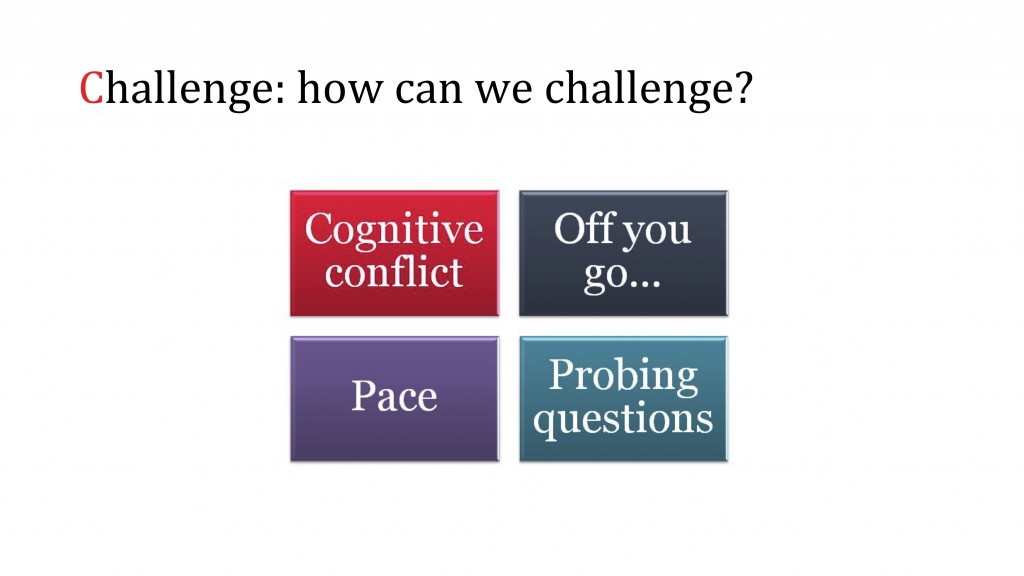
Decide on the type of challenge you are going to do. Challenge in science lessons can take one of at least four forms. Of course, this is an oversimplification but it is simple enough to be useful in the classroom, so here goes.
- Cognitive conflict – present a scenario that is incompatible with students’ current thinking and then present an alternative idea. This is useful when teaching scientific concepts that are often counterintuitive; for example, show students that a tennis ball and a bowling ball will hit the ground at the same time when dropped from a height.
- Pace – limit the time taken to do something. Be careful using this strategy as it can result in superficial learning. However, it can be useful when looking to find out whether students have developed fluency in a particular procedure e.g. setting up a clamp and stand or carrying out a simple calculation within a time limit.
- Off you go…limit the number of instructions before an open task is set. It is best if the outcome is made explicit at the start so that students know when they have succeeded; for example, separating a mixture of sulfur, sand and food dyes.
- Probing questions – ask fundamental questions that promote integration and reorganisation of existing knowledge e.g. where do the stars go during the day and why are big fierce creatures rare? Other examples of deep questions are here.
Rapid feedback
The best feedback helps students with learning the subject/key concept. It is not overly limited to helping students to get better on only one specific task. As with most feedback, it is best shared while students are doing the task or soon afterwards. If lots of students are making the same mistake then use the whiteboard to re-teach, adjust explanations and address misunderstandings. Remember, if the task is sufficiently well designed students will also get feedback from the task itself.
The role of challenge as a formative assessment tool, ASE conference, January 2016
The role of challenge as a formative assessment tool for science teachers. This presentation summarises how challenge can be used as a formative assessment tool in science lessons. It was delivered at the ASE conference in January 2016.
- Planning lessons: the EPIBA approach
- Clearly defined lesson objectives
- The Do Now
- Activate prior knowledge
- Challenge your students
- Use a context
- Challenge all students appropriately
- Use direct instruction to provide clear explanations
- Model abstract ideas in concrete ways
- Use questioning to probe understanding
- Check for understanding – give and get feedback
- Troubleshooting – why did it go wrong?
Leave a Reply